

The Dormition of the Theotokos: What the Feast Means and How to Choose an Icon for It
On the fifteenth of August the Orthodox world stops. Villages empty into churches, islands fill with pilgrims, and the name Maria is spoken in a thousand greetings. It is the feast Greeks call the Easter of Summer — and after Pascha itself, the most beloved day in the calendar. What follows is what the Church remembers on this day, how to read its icon, and — at the end, for those choosing one — some practical guidance.

What the Church remembers on August 15th
The Gospels say nothing about the end of the Virgin's life. What the Church holds instead is a memory carried from the earliest centuries and preserved in the hymns, the synaxarion and the icon of the feast.
It begins at the Cross. From there Christ entrusted His mother to John the Evangelist, and she went to live in his house, together with his brother James and their mother Salome — who was herself a kinswoman of the Theotokos. She lived there quietly for years, in the ordinary company of a family.
When the time came for her earthly life to close, an angel of the Lord came to tell her — tradition holds that it was the Archangel Gabriel, the same messenger who had come to her at the Annunciation, closing a circle opened a lifetime earlier. He came three days before.
The tradition is careful to record her response, and it is not what we might expect: her joy was great. She was going to meet her Son. She went up to the Mount of Olives to pray — the same slope where Christ Himself had prayed — and then returned to John's house and told them plainly what was coming.
On the third day the Apostles were scattered across the world, preaching from Rome to India, and there was no time to gather them. And so, the tradition says, a cloud caught them up and set them down together at her bedside. With them came others: Dionysius the Areopagite; Saint Hierotheos, who had been Dionysius's own teacher; the Apostle Timothy; and other hierarchs of the early Church. The room held the first generation of Christianity, assembled in a single hour.
She fell asleep surrounded by those she had raised in the faith. The Church has never called it death. The word is koimisis — a falling asleep. With psalms and hymns they carried her to the tomb in Gethsemane.
One of the Apostles was not there. Thomas — who else — arrived after the burial, and asked that the tomb be opened so that he too might venerate her body. On the third day they opened it, and found it empty. She had been raised bodily and taken up. What began as his absence became the Church's certainty.
The synaxarion of the feast puts the whole matter in three lines, as the Byzantines liked to do:
Οὐ θαῦμα θνῄσκειν κοσμοσώτειραν Κόρην,
Τοῦ κοσμοπλάστου σαρκικῶς τεθνηκότος.
Ζῇ ἀεὶ Θεομήτωρ, κἂν δεκάτῃ θάνε πέμπτῃ.It is no wonder that the Maiden who saved the world should die,
since the Maker of the world died in the flesh.
The Mother of God lives for ever, though on the fifteenth she died.
This is why the feast is not a funeral, and why Greeks call it the Easter of Summer. It is the first working-out of the Resurrection in an ordinary human life, and the promise attached to it is meant for everyone. To this day the Church answers her with the same words: Χαῖρε, ὦ Μῆτερ τῆς ζωῆς — Hail, O Mother of Life.
Reading the icon
Once you know what to look for, the icon reads like a sentence — and this is worth learning, because it is the same grammar in every icon you will ever own.
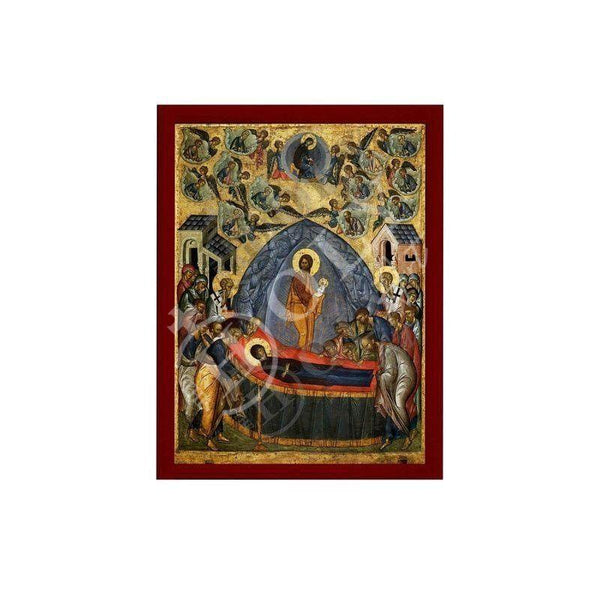
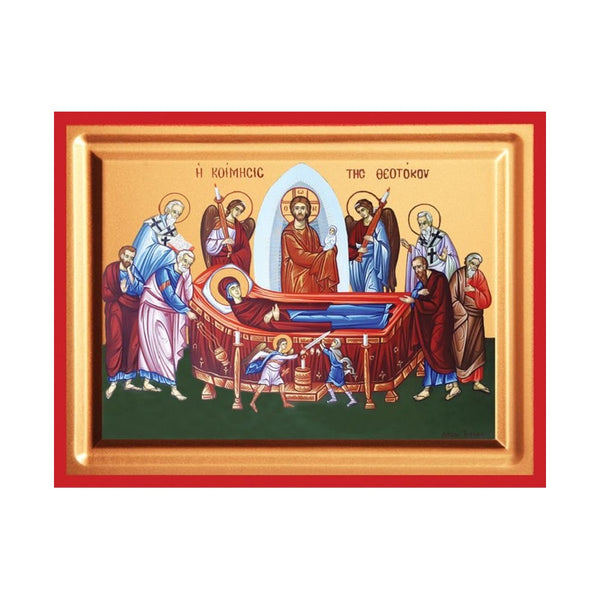
At the centre, the bier. The Theotokos lies with her hands folded and her face at rest. The iconographer paints repose, not agony, and the difference is deliberate.
Behind her, Christ, taller than everyone, often standing within a dark almond of glory — the mandorla, which marks uncreated light. In His arms He holds a small child wrapped in white swaddling bands. That child is His mother's soul.
Look at what the painter has done. At the Nativity, she held the swaddled infant; here, He holds her. The composition of Christmas has been turned inside out, and the message needs no caption: death has become a birth.
Around the bier, the Apostles. Peter censes at her head; Paul bows at her feet. Among them, in fuller versions, stand the bishops the synaxarion names — Hierotheos and Dionysius the Areopagite, shown in episcopal vestments. Their grief is real but ordered; the iconographer does not let it spill into chaos.
Above, the heavens open, and angels wait to receive her. In fuller compositions the Apostles appear a second time in the upper corners, borne on clouds — the same men shown twice, because an icon is not a photograph of one moment. This is the cloud of the tradition, painted literally.
And at the bottom, sometimes, a detail that stops people: a figure with severed hands kneeling before the bier. This is Jephonias, who according to tradition reached out to overturn it and was struck by an angel's sword; he repented and was healed. Iconographers keep him not for cruelty but as a reminder that the holy is not handled carelessly — and that even the worst impulse can be forgiven.
Our Dormition of the Virgin Mary icon shows the full composition: Christ with her soul at the centre, the Apostles gathered, the heavens open above.
If this is your first icon
A good number of the people who write to us in August have come into the Orthodox Church recently, and this is the first icon they have bought. If that is you, a few things worth knowing, none of them obvious from outside.
There is no wrong first icon. People worry about this more than they need to. The usual counsel is to begin with Christ and the Theotokos — those two are the foundation of any prayer corner — and to add a patron saint or a feast that means something to you.
An icon is not a painting of someone. It is treated as a window: you do not pray to the wood, you pray before it. Practically, that means it wants to be somewhere you will actually stand — not above a television, and not in a hallway you pass through without stopping.
The prayer corner is simpler than it looks. Traditionally it faces east. An icon, a vigil lamp or a candle, perhaps a censer and a small bottle of holy water. That is genuinely all. It grows over years; it does not need to arrive complete.
And you can simply ask. If you are not sure which icon, what the title on it means, or what size makes sense for the space you have, write to us. There is no question too small, and we do not expect you to buy anything in order to ask one. A good part of our day is spent answering exactly these questions, and we would rather you ended up with the right icon than a quick sale.
The fourteen evenings before the feast
The Dormition does not arrive unannounced. From August 1st the Church keeps a fast of two weeks — the strictest of the year after Great Lent — and each evening the Paraklesis is sung: the Supplication to the Mother of God, alternating between the Small and the Great.
Anyone who has stood in a Greek church on a warm August evening knows the sound: doors open, the heat not yet broken, the same refrain returning again and again. Many families keep the fortnight at home too — an icon of the Panagia, a lamp lit at dusk, a few minutes of quiet. If you are looking for a place to begin a household practice, this fortnight is the traditional one.
Name day of half of Greece
August 15th is the largest name day in the Greek calendar. Everyone named for the Mother of God celebrates: Maria, Panagiota, Panagiotis, Despina, Mariana, and every diminutive — Marika, Popi, Depy. In the diaspora the day carries even more weight, because it is one of the fixed points where a family spread across time zones still calls one another.
If you are new to this: a name day is celebrated more than a birthday in Greek families, and an icon of the saint or feast a person is named for is the traditional gift. It is not consumable and not decorative. It goes on a wall and stays there, often long enough to be handed on.
"Is this a Byzantine theme?"
A question we hear constantly, and it deserves a straight answer: yes — and here is what that actually means.
An Orthodox icon is not an artist's free interpretation. The composition of the Dormition has been substantially fixed for over a thousand years: the same figures, in the same positions, with the same gestures. An iconographer is not inventing a scene; they are writing a known text in paint. That is why icons of the same feast from Crete, from Mount Athos, and from a workshop in Katerini are recognisably the same image, however different the hands that made them.
So when someone asks whether a piece is a genuine Byzantine theme, they are really asking: is this canonical, or is it religious decoration? Everything we make follows canonical prototypes. If you are ever unsure about a specific piece, ask us — we will tell you which prototype it follows and where it comes from.
Lithography, serigraphy or silver?
The question we field most often: what is the difference between a lithography, a serigraphy and a silver icon? Here is the short version.
Lithography is a printed image mounted on wood. It is the most affordable way to have a canonical icon in your home, and there is nothing improper about it — printed icons hang in countless Orthodox households and are blessed in churches every week. What you are buying is a faithful reproduction of the prototype, not a unique object.
Serigraphy — silkscreen — is a step up, and it is our main line. The image is screen-printed onto a prepared wooden or canvas surface, then finished by hand. This is the range most people choose when they want something that reads as a real icon rather than a print.
Sterling silver icons are a different object again: the image worked in 925 sterling or 999 fine silver, often gold-plated in the Byzantine manner, in miniature format. These are what people choose when the occasion is meant to be remembered — a baptism, a wedding, a godchild's first icon. Small by design, made to be handled and kept.
We have written a fuller comparison of the three in our guide to Orthodox icon types, if you would like the detail.
Which icon for this feast
Two directions, both correct.
The Dormition itself — the feast scene described above. This is the liturgically precise choice, and it suits someone who follows the calendar closely or is being given the icon expressly for the feast. Our Dormition of the Virgin Mary icon follows the traditional composition, and there is also a version on carved wood with a raised, tactile surface.
Or an icon of the Theotokos herself — Glykophilousa (the Sweet-Kissing), Axion Esti, Gerontissa, Amolyntos, the Softener of Evil Hearts. These are the icons people actually live with, and for a name-day gift they are usually the warmer choice. Each has its own history and its own tenderness; tell us about the person and we will help you match one.
On size. The question we are asked more than any other, so here is the honest answer: 20×27 cm is the size to choose if you are choosing only one. It is about the size of a sheet of Letter paper (A4 in metric), which makes it easy to picture before it arrives. That size holds its own on a wall, works as the centre of a prayer corner, and is still small enough to sit on a shelf or a chest of drawers without dominating the room.
Smaller sizes — roughly 10×15 cm and below — are for a desk, a bedside table, a car, or for travelling. They are lovely, but people who buy one as their only icon often write back later wanting something larger. Larger sizes, 30×40 cm and up, are for a wall that is meant to be seen from across the room, or for a gift where the scale is part of the gesture: a wedding, a new home, a memorial.
Everything is made and finished in our workshop in Greece and shipped worldwide. If a piece is made to order, we will tell you honestly how long it needs before you buy.
Icons for the Dormition
Browse all icons of the Panagia →
We are a family workshop in Greece. Everything we sell is made and finished here by hand, in the Byzantine tradition, and shipped worldwide. If you are choosing for a particular person, a particular feast, or your first prayer corner, write to us — questions are welcome and no purchase is expected.